Web design
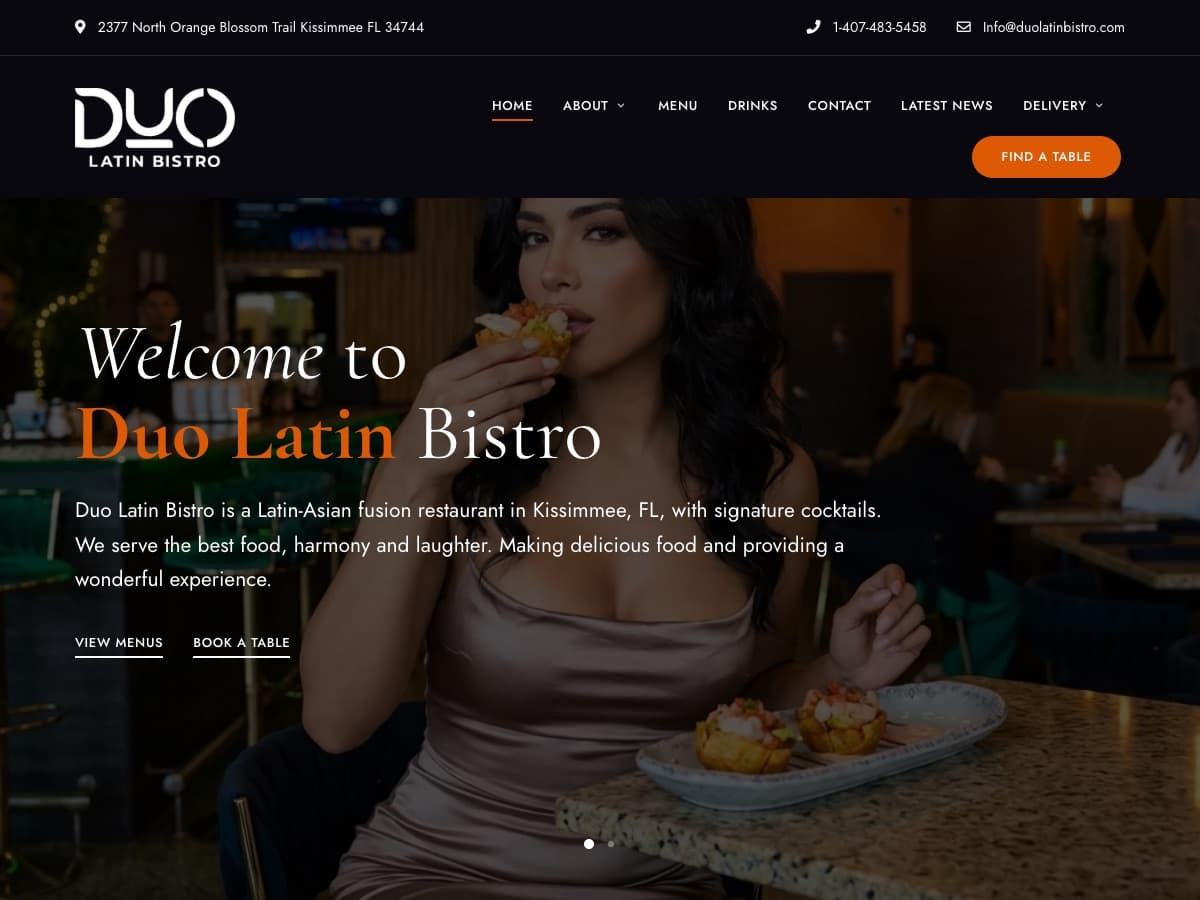
Duo Latin Bistro
Website for a Latin-Asian fusion restaurant in Kissimmee, with menus, table booking and delivery links.
Visit the siteRestaurant website design
Most restaurant sites fail the same way: the menu is an image Google cannot read as text, and booking takes too many taps. We build the site around the three things people come to do: see the menu, book a table and order.
The short answer
Restaurant website design has to solve three things on mobile: a menu in text that Google can read, booking in a few taps and ordering without detours. Henoc Marketing builds bilingual restaurant sites, with a menu your team can edit and a connection to your booking system. Websites start from $997 and the first consultation is free.
Last reviewed:
They show up on a great many restaurant sites, and none of them has to do with how pretty the design is.
Google does not read the dishes inside an image as text, so you do not show up when someone searches "birria near me" or "gluten free brunch". A PDF can be indexed, but as a file separate from your page, and on mobile it forces pinch-zoom.
A button that opens another page, that opens a widget, that asks you to create an account. Every step loses people, and the decision of where to eat gets made fast, and hungry.
Stale hours, a hard-to-find address and nothing about parking, patio seating, large groups or whether kids are welcome. These are the questions people call to ask, and every call you answer is a table you are not serving.
Delivery platforms charge a commission on every order. If your site does not offer an equally easy way to order direct, you pay that commission even on customers who already knew you and came looking for you.
Mobile first, always. It is where tonight's dinner gets decided.
Every dish in real text, with price and allergens, plus schema.org menu markup. That way Google can surface your dishes and an AI assistant can answer what you serve when someone asks.
Buttons that do not vanish on scroll, connected to your booking system and, when it offers an integration, to your POS. No account creation and no detours.
Large groups, private events, catering and odd questions. An AI agent answers instantly in Spanish or English and hands off to a person when the case calls for it.
All built for mobile and for your team to update without calling us.
You change prices and dishes without depending on anyone. We train you to do it.
With the system you already use, or we help you choose one.
Pickup or delivery, without the platform commission on every ticket.
Compressed so they load fast on mobile data, not just on office wifi.
Large orders tend to come through here, and few sites work it.
Hours, parking, patio, accessibility and restaurant schema consistent with your Google profile.
Written by people, with dishes under their real names. Included at no extra cost.
Bookings and orders after hours, when nobody is on the phone.
Three differences you notice in the operation, not in the portfolio.
Duo Latin Bistro, in Kissimmee: a site with menus, table booking and delivery links. You can see it live, with their permission, below.
Shipping the menu as an image looks good and is less work. We lay it out in text with structured data, which is the difference between showing up or not when someone searches for a specific dish.
A machine-translated menu shows in the first line and costs credibility exactly where it matters most. We write both versions, and bilingual is included in the price.
The standard process takes four weeks: strategy and content in week 1, design and development in weeks 2 and 3, launch and training in week 4. Integrations and content reviews can stretch it, and the delivery date goes in writing in the quote.
Menu, hours, booking system and the POS you already use.
Week 1
Mobile-first visuals, the text menu, booking and ordering integration, and testing on a real phone.
Weeks 2-3
Go live, Google Analytics and Search Console, and training so you edit the menu yourself.
Week 4
The same mobile-first, frictionless booking approach applies here.
WhatsApp orders and reservations for your Orlando restaurant.
Direct bookings without going through travel platforms.
Visible booking and priced services.
Class schedules, free trials and online membership signup.
If you also sell packaged products.
The ten industries we work with.
Our published prices. A menu with reservations fits the smaller sites; online ordering and POS integration push toward the Pro website.
From $997
1-3 pages, bilingual EN/ES
From $2,497
Up to 8 pages, bilingual EN/ES
From $4,497
9+ pages or integrations
From $1,997
With redirects so you keep your Google rankings
$147/mo
Hosting, SSL, backups, security monitoring and 1 hour of changes a month
Care plan (maintenance) is monthly: 6-month minimum, then month-to-month with 30 days' notice. If you cancel within the first 30 days, we refund your first monthly fee (setup, ad spend and usage are non-refundable).
A live site shown with the client’s permission. We show what is visible on the live site, with no results figures.
Web design
Website for a Latin-Asian fusion restaurant in Kissimmee, with menus, table booking and delivery links.
Visit the siteWe operate out of Orlando, Florida, serving Central Florida on site. Everything else is remote, so we build restaurant sites anywhere in the United States and in the Dominican Republic. Local experience changes the outcome in one concrete way: in Central Florida plenty of people search for where to eat in English and plenty in Spanish. A site that exists in only one language leaves out the other half of the conversation, and that does not show up in analytics tools that only look at English.
Thirty minutes to look at your menu, your booking system and where orders come in today. You leave with a written quote, or with a fix list if your current site can be saved.